

"I'm Elliot, from Acme-XYZ. We're doing some inventory on the PBX systems," I interjected, casually flipping through a clipboard I'd grabbed from outside.
Assessment Background
We threw on a couple of standard, boring white button-up shirts, gray slacks, and ties that barely passed for office-ready. Our badges? Freshly printed fakes, knocked out that morning at the hotel and hung around our necks with cheap color-matched lanyards. Nothing fancy, just enough to blend in.
The moment we stepped out of the car, we were hit with the unmistakable smell of barbecue and the sound of what was likely a Yacht Rock top 10 playlist. Sure enough, we followed the music straight into a full-blown company party. A quarterly employee appreciation cookout was in full swing, complete with large tents filled with tables and chairs, buffet lines, a DJ, and for some reason a bouncy castle, even though it was clearly an all-adult crowd dressed in business casual.
The place was packed. The mood was light, the vibe much more relaxed than the run-of-the-mill corporate environment, regardless of the data they housed. Everyone was distracted, badges swinging from necks and belt clips as they lined up for pulled pork and potato salad. It was the perfect storm. No one looked twice at two more "employees" showing up to grab a plate. So we did what anyone would do. We got in line. We wanted to clone badges and gather intel. We were also hungry.
We made small talk while we waited for food, not just to blend in but to build rapport. The more conversations we had, the more we learned how to "belong." And it worked. It worked so well that a couple of employees ended up saving us seats in the tent so we could eat with them and keep cracking jokes about the bouncy castle and last night's UFC match. While we casually enjoyed smoked brisket and sweet tea, we were also picking up intel. Names of department heads, current projects, pain points of the job, you name it. Just by listening and asking a few friendly questions, we started building out a mental map of the company.
After we finished eating, the group we were with said they needed to head back inside. "We'll catch up," Tim and I said, casually peeling off to grab another sandwich with our partner Drew. That's when it happened.
They held the door for us.
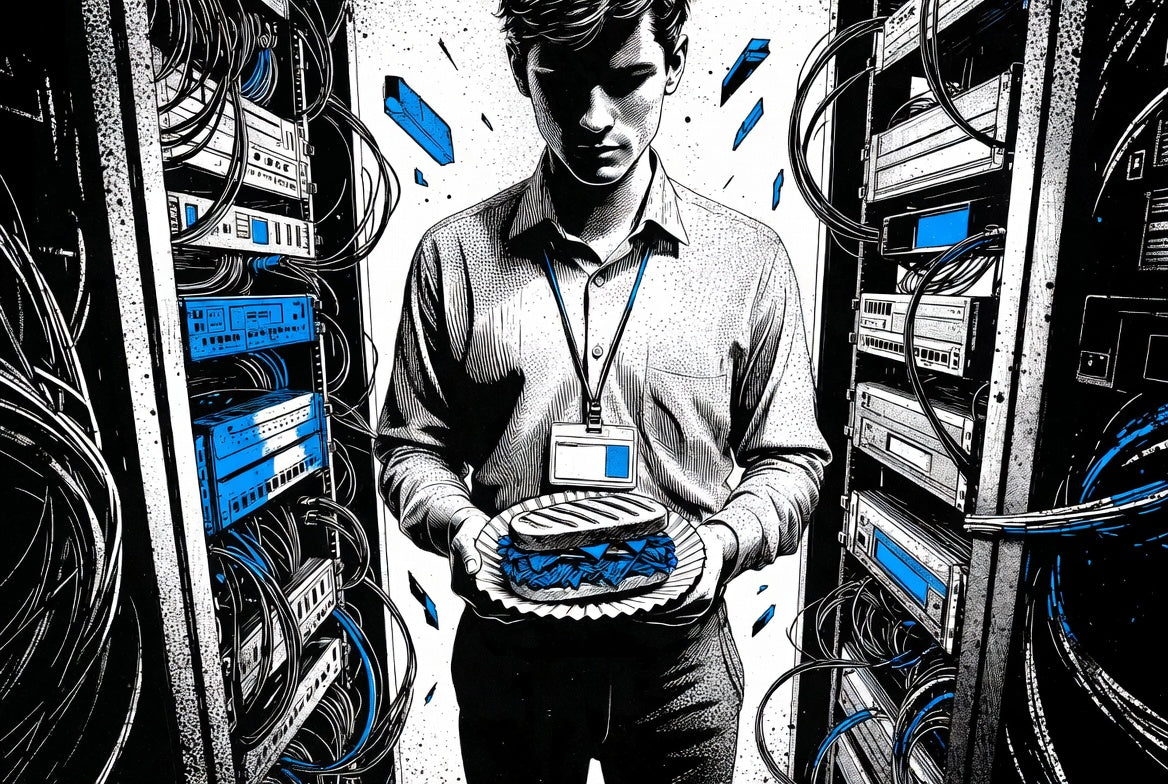
BBQ sandwich in hand, we followed them in like we'd worked there for years. They had no idea it was our first time stepping foot inside the building.
Sometimes the best access doesn't come from a cloned badge, a bypass tool, or a lockpick. It comes from showing up to the party, smiling at the right moment, and knowing how to blend into the crowd.
On Site
Bellies full and task list ready, we were in, and we'd even made a few new friends in the process. But as soon as we stepped through the door, we hit an unexpected speed bump. A corporate group photo op. Seriously?
A very enthusiastic employee waved us over. "Hey! Group picture time!"
There was no way to get out of it without looking suspicious, especially since our new BBQ buddies were already waving us in. Tim, Drew, and I just gave each other that look. I guess we're doing this.
We stood in front of the most aggressively corporate backdrop you could imagine. WE ASPIRE in bold across a city-scape banner. Just before the photo, one of the photo staff stopped us. "Wait! You need to put your badges in this bin so they don't show up in the picture."
"Great idea!" Tim said, smiling as we reluctantly dropped our totally fake badges into the bucket, silently praying no one took a closer look. (Drew looks a bit like a Baldwin, so we made his badge photo a headshot of Alec Baldwin. No one noticed.) Tim also placed the clipboard with the badge cloner in it on top of the stack of badges, hoping to glean one or two. Brilliant move. It was such a natural motion that no one thought twice about it.


Click. Flash. Done.
Each of us in the photo received an instant printout. We had to stand around and keep up the small talk while we waited for our copies to come out of what had to be the slowest color photo printer we'd ever seen, or so it felt. It was hard for the three of us to keep our composure and not laugh out loud. To this day, we still have that photo as a trophy from the op. No idea who we're standing next to. Sorry, [Insert Name Here].
As we grabbed our badges out of the bin, along with the clipboard, we tried to sneak in another quick scan of the other badges using our cloner, just in case the basket drop didn't work. No luck. We were being watched too closely and the angle was wrong for our older ProxMark antenna boosters. Oh well. The moment had passed to make the action look natural.
Picture in hand, we made our way deeper into the building, still eating our sandwiches, nodding and waving to folks we'd just met like we'd worked there for years. We ate slower than normal. The sandwich became a prop, a quiet signal to others that we belonged. After finishing the last bite, we ducked into a stairwell to collect our thoughts and gather our game plan. Based on earlier recon, we had a pretty good idea where we needed to go. Our targets: the server room and the PBX (Private Branch Exchange) closet.
Switching Roles
Now that we were deeper into the building, with the lunch hour ticking away and the lax attitudes from the BBQ wearing off, people would start paying more attention, especially near sensitive areas. We knew it was time to switch up our roles. Tim went from being an employee to playing the part of an escorted contractor. He walked the halls with a clipboard and a casual nod to anyone who glanced our way, while I stayed close behind, focused on gaining access to the restricted areas. I took on the guise of the corporate employee escorting him, exchanging small shop talk and matching his body language to sell the cover as we mimed our way through the halls, unnoticed.
Most of the badge-restricted doors were fitted with standard commercial ADA lever handles, the kind often prone to over-the-door or under-the-door tool attacks. Through the narrow glass pane on one door, poorly obscured by a piece of paper and some masking tape, we could see what looked like a sensitive area. Server racks, wiring, the works. The door was locked and we hadn't yet cloned a valid badge for it.
No problem. We had just the thing.
While one of us stood lookout, the other got to work with the under-the-door tool, basically a wire with a coated string that slips beneath the door and lets an attacker open it from inside by exploiting the ADA compliance for egress, pulling down on the internal lever handle. A little light banter between us about "OSHA compliance" and inventory covered the action as a couple of employees strolled past, plates of BBQ in hand. They didn't give us a second thought. Once the coast was clear, click, the lever handle turned from the inside and we were in.
The window helped tremendously with lining up the UtD tool. There are times when we can appreciate a sloppy job on something, and the lack of window covering was one of them. We also didn't know if any employees were already inside the room. It was a chance we were willing to take, since we had a pretty good cover story ready. Luckily, the room was empty.
The Server Room
As the assessment continued, we used the same method to slip into several more badge-controlled areas, including the primary objective, the server room. Inside? Jackpot. All the things we needed to tap phone lines and eavesdrop if we wanted: PBX gear, test phones, butt sets, real phone phreak nostalgia, and a ton of sensitive infrastructure ready for inspection.
We were mid-harvest, desk drawers opened with lock picks and binders pulled out for review, when two employees badged in. They sat down at their laptops, and only one looked up at us.
"Who are you guys?"
"We're with Acme-XYZ," Tim answered smoothly, flipping through the fake checklist print-offs on the clipboard. "Doing inventory on the PBX systems." Drew nodded toward the rack.
"Yeah," I said. "Also checking connectivity. By the way, do you happen to have a butt set back here? I think I left mine in the truck."
The guy nodded toward a cabinet, eyes barely leaving the monitor and whatever project he had his head buried in. "There's one in there you can use."
Perfect. They never asked for ID or verification. They just rolled with it. We gave them no reason to question our story, because we held our roles. The smell of brisket and generic badges dangling from our necks gave us enough credibility. The fact that we were already in the server room played a part too. Never mind how we actually got in there.
Once we had enough client interaction and data to justify leaving before they got suspicious, we split up. I circled back to the BBQ to mingle a bit more and grab another sandwich (a prop), keeping up appearances and giving anyone the chance to challenge my "employee" cover. Walking around and eating inside a building sends a subtle, highly believable message that you belong. It shows you're comfortable, and clearly working on something that requires you to eat and work at the same time. Meanwhile, Tim slipped further into the building, past a bank of cubicles that looked like the networking team's home base.
The Data Center
That's when we found the data center.
This one had two-factor access. An unencrypted, low-frequency proximity badge and a PIN. A nice change from all the basic locks we'd seen so far. A suction cup tile puller sat nearby, practically inviting someone to go under the drop floor and avoid the door altogether, but Tim's white shirt made that a little too risky to explain if he got caught crawling around. Instead, he went with the tried-and-true UtD tool again. Different door, same result. The door popped open, no badge or code required. As far as the alarm system was concerned, it registered as someone simply leaving the room.
Once inside, he messaged Drew and me to meet up. Unashamedly, I finished my third sandwich (protein) and walked with a purpose. Drew refilled his tea and followed.
The room was a gold mine. Core switches, employee laptops, VPN kits, and sensitive systems all humming quietly in the dark. We collected everything we needed: documentation, IPs, photos, inventory tags, anything that proved access and exposure. Tim also filled out a few of the fake forms on his clipboard to bolster his guise in case we got challenged on who we were or what we were doing.
The Executive Copy Room
On the way out, we passed by the "Executive Copy Room" and decided to check the printer for exposed data. Sure enough, an employee was standing by the machine.
"Oh hey," I said, casually walking up and pulling the toner out. "You waiting on a print job?"
"Yeah, sorry, did I mess something up?"
"Not at all. Could you do us a quick favor though? Just need to check the toner. Should only take a sec. Actually, did you get what you printed?"
"Yes," they said, handing me what the printer had spit out. An SSN, DOB, address, full name, and photo ID. Classic.
"Would you mind printing it again real quick?" we asked, as Drew tossed the original into the nearby shred bin.
"Sure, no problem!" they said, walking off.
As soon as they were gone, we picked open the shredder bin lock and grabbed the document right back, logging the exposure. The second copy was printing as we quietly stepped out, leaving the employee none the wiser.
Wrapping Up
By this point we had accessed every sensitive area on our target list. We had also been through nearly every cubicle and office, pulling PII and other sensitive information from desks, server rooms, and printer trays. We filled our stomachs, took a picture, and made a few acquaintances. We achieved all objectives and then some. There was nothing more we could do. It was time to head home.
Baseline Security Issues
This assessment was a reminder that most of the time, you don't need to force your way through a door. You just need to walk through it like you belong there. Confidence, timing, and a decent story still go further than most controls in place. From BBQ small talk to flipping toner cartridges and popping server room doors, this job checked all the boxes: blending in, building rapport, exploiting trust, and bypassing access with tools and charm alike.
No alarms were triggered. No one stopped us. The fake badges, made hours before in a hotel room, held up under casual scrutiny. And if they hadn't, we would have just smiled and kept talking until no one noticed. Employees welcomed us into the building, saved us seats at lunch, and even handed over details about technical issues and pain points, thinking we were somehow going to do them a favor by fixing them.
What this really drove home is something we've seen over and over. People trust what looks familiar. If you dress the part, speak the lingo, match the energy, and show up at the right time, even the most secure environments start to unravel. And while tools like the under-the-door kit or a badge cloner are nice, the human factor is what gives us the biggest advantage.
The gaps we exploited weren't because of a lack of logical or physical controls. They were because people are busy, distracted, or too polite to question what feels off. That's the real vulnerability. And unless that changes, the next attacker won't need to be clever. They'll just need to show up with a fake badge and a good brisket sandwich.
The specific issues we documented on this engagement break down into the following categories.
Badge and Credential Controls
- Lack of Stringent Badge Verification: Employees and visitors were able to bypass security checkpoints using forged badges and without proper authentication, particularly during company events where verification was minimal.
- Inadequate Enforcement of Authentication Procedures: There was a failure to validate the identities of individuals claiming to be contractors or inventory personnel, leading to unchecked access to sensitive areas.
Physical Access and Door Hardware
- Inadequate Monitoring of Entry Points: There was a lack of thorough validation for entry into restricted areas, allowing unauthorized individuals to gain access without proper checks.
- Vulnerable Door Hardware: Doors to sensitive areas had uniform lever handles and an oversized gap between the door and the frame, easily bypassed using basic tools and compromising physical security.
- Lack of Two-Factor Authentication: Critical areas, such as the data center, relied on single-factor methods (PIN only or proximity badge only) without additional layers of security, and the door itself could be opened from the outside without either credential.
Document Handling and Printing
- Poor Document Handling Practices: Sensitive documents were frequently left unattended and disposed of in unsecured shredder bins, risking exposure of confidential information.
- Lack of Oversight in Printing and Document Management: Print jobs containing sensitive data were not monitored adequately, allowing unauthorized individuals to access and potentially duplicate confidential information.
Conclusion
Two operators in cheap ties and printed badges walked into a barbecue, ate their fill, posed for a corporate photo, and walked out hours later with everything from PBX intel to a stranger's PII. Not a single alarm went off. Not a single guard challenged them. The fake badges didn't even need to hold up. The smiles, the small talk, and the brisket on a paper plate did most of the work.
That's the lesson worth holding onto. Physical security isn't just about doors, locks, and badges. It's about people, and how willing they are to question what looks familiar. When the mood is light and the badges are swinging, the difference between a co-worker and an attacker is often just a haircut and a confident nod. Build your defenses for the day no one is paying attention, because that's the day someone like us is going to walk in.
We've got more stories coming from the other side of those badge readers. Different doors, different excuses, same lessons. Catch you at the next one.
Share:
Access Log 005: The Key
Access Log 007: Can I See That?