

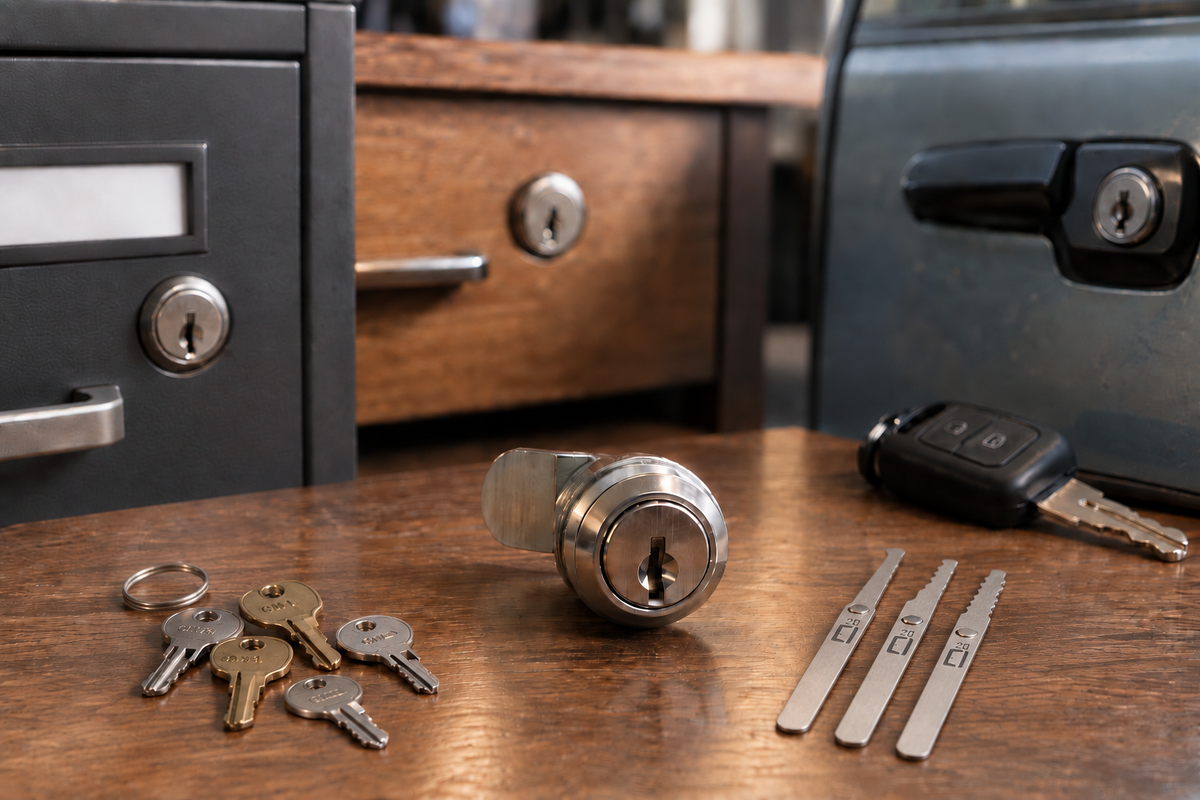
So there's a lock you walk past a dozen times a day and never think about. It's in your desk drawer at work. It's in the filing cabinet next to it, the cash box, the toolbox, the RV door, and a lot of older car doors and glove boxes. It's a wafer lock. And the wild part? It's one of the easiest locks there is to open.
Now, don't let that worry you. Once you understand why, you'll also understand what these locks are actually for. So let's get into how a wafer lock works, how to pick one, and why it opens so much faster than the deadbolt on your front door.
How a wafer lock works
A wafer lock is a close cousin of the pin tumbler lock, just simpler. Instead of stacked pins, it uses flat spring-loaded wafers, thin metal plates sitting in slots across the plug (the part that turns). With no key in, springs push each wafer so it sticks out past the plug and into a slot in the outer housing. As long as a wafer is poking into that housing, the plug can't turn. That's the lock.
The key slides in and each cut on the key pushes a wafer down to exactly the right depth, so no wafer sticks out past the edge of the plug anymore. Everything sits flush at the shear line, and the plug spins. Same basic idea as a pin tumbler, but with fewer, simpler parts.
A lot of wafer locks, especially in cars, are double-sided: half the wafers push out the top, half push out the bottom, and the key is cut on both edges. It looks fancier, but the principle is exactly the same.


Renders by Wapcaplet, CC BY-SA 3.0, via Wikimedia Commons.
Why they open so easily
Okay, so here's why a wafer lock gives up so much faster than a good deadbolt. A few reasons stack up.
- Loose tolerances. Wafer locks are cheap to make, so the fit is sloppy, and slop is exactly what a picker uses. The sloppier the fit, the easier it is to bind one wafer at a time and get it to set.
- Wide, forgiving wafers. The wafers are broad and easy to reach and move, so picking them one at a time is straightforward, and raking (running a pick across all of them at once) works far more often than it does on a quality lock.
- Not many security features. The good anti-pick tricks you find in better locks, security pins and tight machining, mostly aren't there. A wafer lock is built to be cheap and convenient, and that's about it.
Okay, so how do you actually pick one?
Same two-tool approach as any pin tumbler, just more forgiving. The one thing to know going in is that wafer locks want a light touch. Less pressure than you think you need, and then a little less than that.
- Slide your turning tool (what a lot of people still call a tension wrench) into the bottom of the keyway and put just a hair of turning pressure on the plug.
- Slip your pick in and feel along the wafers. With that light pressure on, one wafer will bind harder than the rest.
- Push the binding wafer down until you feel it set, a tiny give at the shear line, sometimes a click you feel more than hear.
- Find the next binding wafer and repeat. There are usually only a handful, four to six in most desk and cabinet locks, so this goes quick.
- When the last one sets, the plug turns and you're in.
And raking works even better here than it does on pin tumblers. Hold that same light pressure and run a rake in and out across all the wafers, and a lot of wafer locks just pop within seconds. If you're brand new, a wafer lock is a great first lock. The feedback is easy to feel and the win comes fast, which is exactly what you want early on.
The jiggler shortcut
Now, wafer locks are so standardized that a whole shortcut category exists just for them: jiggler keys. A jiggler is a wavy, key-shaped blank that roughly matches the most common wafer patterns. You slide it in, hold gentle turning pressure, and rock and wiggle it until the wafers happen to line up. Because the designs repeat everywhere and the tolerances are loose, a small set of jigglers opens a surprising share of the desk, cabinet, and toolbox locks out there.
About that filing cabinet
The most common question in this whole family is how to open a filing cabinet, or a desk, when the key is gone. Everything above applies. It's almost always a basic wafer lock, and a rake or a jiggler will have it open in seconds. Before you pick it, though, look at the face of the lock. A lot of office cabinets and desks have a number stamped right on it, and a replacement key cut to that number costs a few dollars online. If you need the drawer open more than once, that's the better fix. And the one rule that never changes still applies here. Don't pick a lock you don't own or don't have permission to open. That includes the cabinet at work, unless somebody authorized asks you to get it open.
So what are wafer locks actually for?
Match the lock to the job, same rule as always. A wafer lock is a "keep honest people honest" lock. It stops your coworker from idly opening your desk drawer. It keeps a kid out of the glove box. It marks a boundary and asks people to respect it.
It won't slow down someone who actually wants in, and that's fine, as long as you know that going in. Nobody's putting a wafer lock on a bank vault. The problem only shows up when someone mistakes a desk-drawer lock for real security.
Want to feel it for yourself?
Our practice wafer lock is a real wafer cam lock, the same format that's in the desk and cabinet locks this whole post is about, so what you learn on it carries straight over. If you want the shortcut and the lesson in one box, the jiggler picks and wafer lock bundle pairs a jiggler set with that same lock.
If you want picks to go with it, our lock picks collection covers everything from a first set to the profiles you'll reach for on a wafer lock. And if you're brand new to all of it, start with the beginner's walk-through and come back to wafers. They'll feel easy after.
Anyways, there's probably a wafer lock within ten feet of you right now. Go find it, shine a flashlight into the keyway, and look for the flat edges of the wafers sitting in a row. Once you've seen them, you can't unsee them, and every desk and cabinet key you pick up afterward will make a little more sense. As always, I appreciate you.
Share:
The Man Who Picked the "Unpickable" Lock at the 1851 World's Fair