

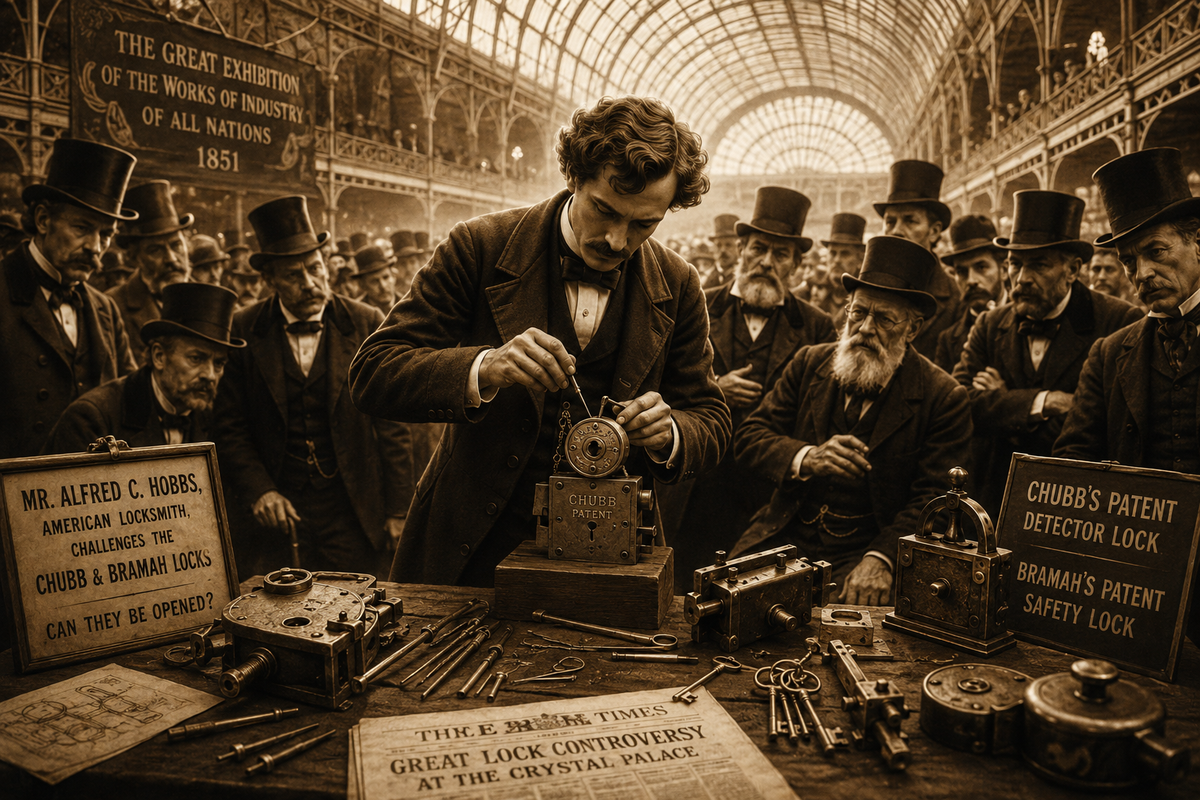
So in 1851, London threw the Great Exhibition, the first real world's fair. They built a palace of glass and iron in Hyde Park to hold it, big enough that full-grown elm trees stood inside, and some six million people came through the doors. The British Empire was showing off the best of everything it made, and some of the proudest things on display were the locks. British locks were the finest in the world, everybody knew it, and the crown jewels of the industry were locks with a reputation for being flat-out unpickable.
And then a quiet American locksmith named Alfred Hobbs walked in and picked one of them in twenty-five minutes, in front of witnesses. The papers called it the Great Lock Controversy, and for a few weeks it was a genuine national scandal. So let's get into what happened, why it rattled people so badly, and why I'd argue it was the best thing that ever happened to locks.
The lock that couldn't be picked
To understand why this stung, you need to know what the Chubb detector lock was and where it came from. In 1817, somebody burgled the Portsmouth naval dockyard using false keys, and the British government did something surprisingly modern about it: they announced a competition. Build a lock that opens only with its own key, win a hundred pounds, which was serious money then, several thousand in today's terms. A Portsmouth ironmonger named Jeremiah Chubb answered with a design he patented in 1818, and it took the prize.
For those of you that don't know what a lever lock is, picture a row of flat metal plates inside the lock, each one needing to be lifted to exactly the right height before the bolt can slide. Plenty of locks worked that way already. Chubb's trick was right there in the name: his lock detected tampering. Lift any one lever a hair too high, the way a picker feeling around in the dark tends to, and a mechanism called the regulator tripped and jammed the whole lock solid. Not broken. Jammed on purpose. It wouldn't open for anybody, including the right key, until it was reset, and an owner whose key suddenly wouldn't turn knew for a fact that somebody had been at their lock. It couldn't be picked quietly, because it tattled.

And that reputation wasn't just talk. The story goes that Chubb's lock was handed to a convict on one of the prison hulks in Portsmouth harbor, a locksmith by trade who had picked every lock ever put in front of him. The deal: open it and you get a free pardon from the government, plus a hundred pounds from Chubb himself. Freedom and money, sitting on the other side of one lock. He worked at it for months and gave up. For more than thirty years after that, nobody did better. By the time the Exhibition opened, the design had grown from four levers to six, and "unpickable" wasn't a marketing claim anymore. It was just what everybody knew.
Funny enough, the thing that reportedly first made Chubb locks a household name wasn't the dockyard prize or the convict. It was King George IV accidentally sitting on one with the key still in it.
The American with a lock to sell
Now, about Hobbs. Boston kid, born 1812, son of a carpenter, and by 1851 he was in London representing a New York lock company called Day and Newell. He'd sailed over to show off their pride and joy, the Parautoptic lock, and he had a very particular style of salesmanship: he didn't tell you his lock was better, he showed you that the other guy's could be opened. Honestly, it's hard to argue with the pitch. He couldn't rig the demonstration, because the lock he was demonstrating on was yours.
So he took on the most famous lock in Britain.
Twenty-five minutes
Okay, so what does it actually take to pick a lever lock like that? Same core idea as picking the pin tumbler on your front door, just different furniture. You put a little rotational pressure on the bolt with one tool, which makes one lever bind harder than the rest. You lift that lever with another tool until it reaches the height where the bolt can pass, feel it set, and move to the one that binds next. Lever by lever, the lock tells you what it wants, as long as you're listening carefully and you never lift anything too far. Which, on a detector lock, is the entire problem. The Chubb was designed to punish exactly the exploratory lifting that picking depends on.
On July 22nd, 1851, in front of witnesses, Hobbs went to work on a Chubb detector lock mounted on an iron vault door. He opened it in about twenty-five minutes. Then, to make the point unmistakable, he relocked it and picked it again in seven. Eleven people signed statements confirming what they'd seen. Small tools, no damage, no force. And by most accounts, the famous detector wound up helping him, because a mechanism that reacts when a lever goes too high is also, if you're patient, a mechanism that tells you something about where the levers are.
The reaction was something close to national panic, and the papers didn't hide it. One London paper admitted that before the Exhibition, Britain had reckoned its best locks "quite as impregnable as Gibraltar." That belief was the real thing Hobbs broke, more than any lock. The affair got its name, the Great Lock Controversy, and it ran in the press for weeks while everybody argued about whether the pick had been fair.
And Hobbs wasn't done. Before the summer was out he took on an even more legendary challenge, a lock that had been sitting in a London shop window for decades with a standing cash prize on it, daring the world to try. That one cost him a whole lot more than twenty-five minutes, and it's a big enough story that it's getting its own Dead Drop soon.
Now, the other side of it
Now, the lockmakers pushed back hard, and honestly their argument holds up.
The pushback, printed at the time, went like this: sure, Hobbs opened it, but look at the conditions. He had unhurried access. He had his own tools. Nobody was rushing him or chasing him off. A real burglar breaking into a real building would never get those "most favourable circumstances," as one banking magazine put it, circumstances that "practically could never exist." And that's not wrong. Picking a lock on a workbench with all the time in the world is a very different thing from beating it on a dark street in ninety seconds. That distinction is real, and any honest picker will tell you the same thing today.
So both things were true at once. The unpickable lock had been picked, and it was still a genuinely good lock. Those don't cancel out.
What happened after
So what happened after all the shouting? Everybody won.
Chubb didn't fold, don't get me wrong. They kept building and kept improving, adding refinements like a curtain that blocked a picker's view into the keyway, and they stayed a respected name in security for well over a century. The reputation even outlived the controversy in the funniest way possible. Decades later, Arthur Conan Doyle was still dropping "a Chubb lock" into Sherlock Holmes stories as shorthand for a door not worth picking. A lock beaten publicly in 1851 was still literary code for unpickable in the 1890s. That's how deep a good reputation roots itself. Keep that in mind whenever the brand name is doing the reassuring instead of the mechanism.
Hobbs did even better. The civil engineers gave him a medal for a paper on lock construction. He started his own firm in London, Hobbs Hart and Co., which kept its Cheapside address for ninety years. And in 1853 his name went on a book that laid the whole trade open, picking methods included, which was a radical thing to print. Then, because apparently one industry wasn't enough, he sailed home in 1860 and spent the rest of his career designing ammunition-making machinery in Connecticut. Some people just have to be building something.
That book had to answer the obvious objection, the same one people still raise about content like this blog: isn't publishing this stuff just teaching burglars? Hobbs' answer is still getting quoted in security circles a hundred and seventy-five years later: "Rogues are very keen in their profession, and know already much more than we can teach them." The crooks already know. Secrecy mostly keeps the honest customers in the dark.
Why it was the best thing that could have happened
It would be easy to tell this as a story about British pride taking a fall. But the real result was better than that.
What Hobbs actually killed was a myth, the idea of the unpickable lock. And that myth was dangerous, because it made people stop thinking. If your lock is unpickable, you don't have to understand it, you don't have to test it, you just trust the label and move on. Hobbs proved that no lock is unpickable. There are only locks that are more or less resistant, that take more or less time, more or less skill. That's a much more useful way to think, and it's exactly how the security world works now: you assume a determined person can get in eventually, and you design around buying time and raising the cost.
People sometimes call the 1851 affair the original bug bounty, and honestly that's fair. A guy showed up, publicly proved that the thing everyone trusted could be broken, and the whole field got more honest because of it. What changed wasn't the companies. It was the thinking.
The thread that runs to today
A hundred and seventy-five years later, the same lesson still plays out over and over. Every time somebody trusts a lock because of its badge or its price or its reputation instead of how it actually performs, they're making the 1851 mistake. A bump key beating a modern deadbolt is the same story as a pick beating the Chubb. The label said secure. The test said otherwise.
So the takeaway from Hobbs isn't that locks are useless. It's the opposite. Locks are tools, and good ones buy you real time and make you a harder target. Just don't mistake a reputation for a guarantee. Understand what you've got. If you want to start actually understanding locks instead of trusting them, the beginner's walk-through is a good place to begin.
Anyways, the next time you watch a modern picker open something the manufacturer swore couldn't be opened, know that you're watching a rerun. Hobbs ran that exact episode in a glass palace in 1851, in front of witnesses, with the whole empire watching, and locks got better because he did. And as always, I appreciate you.
Share:
Open a Padlock With a Soda Can: the Shim Trick, Explained
How to Pick a Wafer Lock: the Lock in Your Desk, Filing Cabinet, and Car