

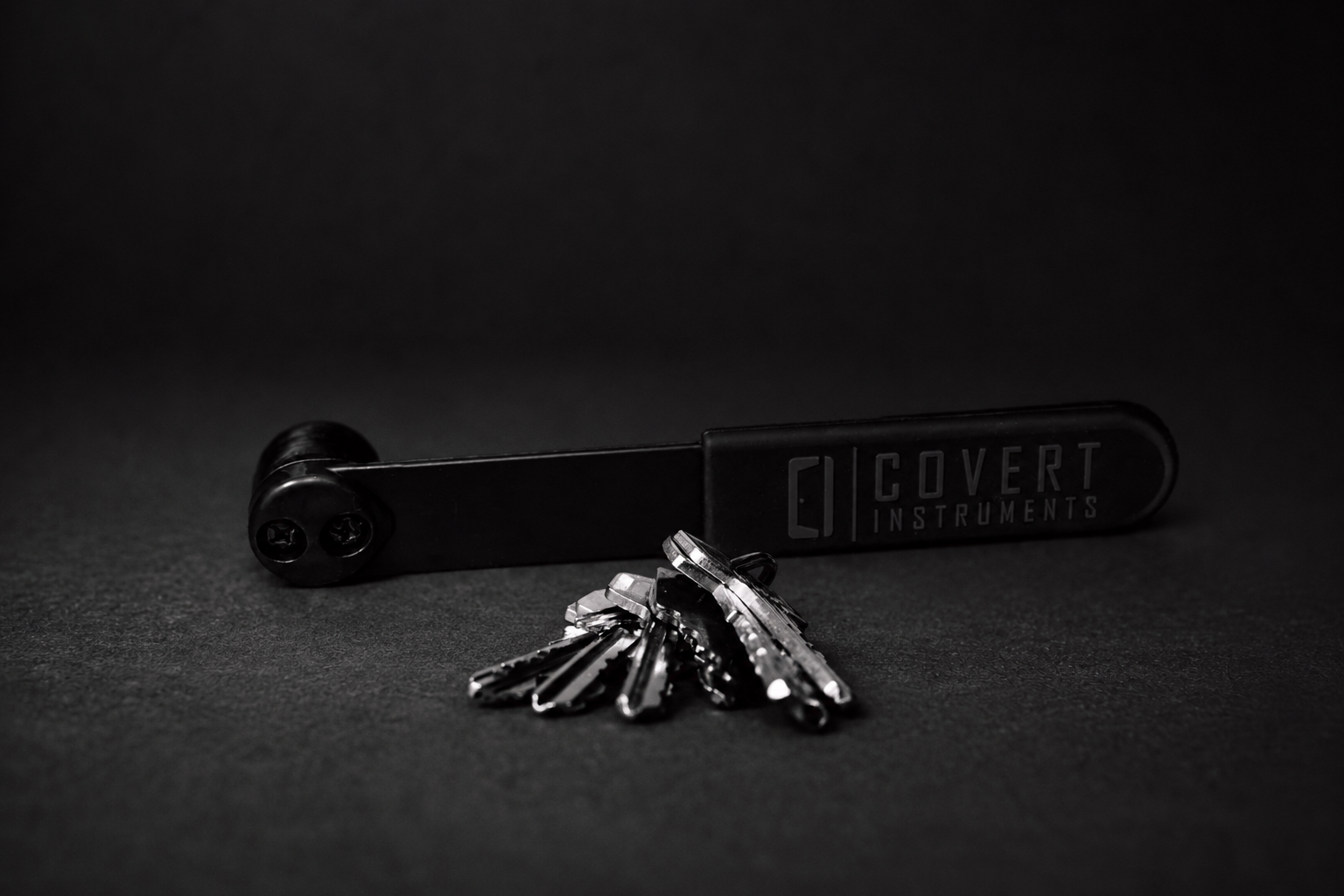
So I've handed a lot of people an ordinary-looking house key over the years and told them it'll open a lock it was never cut for. Not a lock in some lab. A normal deadbolt, the kind that's probably on your front door right now. And the reaction is almost always the same. They slide it in, give it a tap, the lock turns, and they just kind of stare at it.
That key costs about five dollars. And here's the part that gets people every time: there's no picking, no drilling, no reading the lock, no years of practice at the workbench. All the cleverness is baked into how that one cheap key is cut. The key does the hard part, and you just tap it.
That's a bump key. So let's get into what it actually is, how it works, and how worried you should really be. The truth lands somewhere between "your house is a joke" and "nothing to worry about," and that middle ground is the part actually worth knowing.
What is a bump key?
A bump key is a regular key blank for a specific keyway that's been cut all the way down to its deepest possible cut on every position. Pickers call it a "999 key," because every cut is at the lowest depth. That's the whole trick. It's not a magic key, and it's not a master key. It's just a key cut to one very specific pattern.
The catch is that it has to match your keyway. A Kwikset bump key won't do anything to a Schlage lock, the same way your house key won't start your neighbor's car. So bumping isn't one key that opens everything. It's one key per keyway. The uncomfortable part is how few keyways cover so many doors, and we'll get to that.
How lock bumping actually works
Okay, so to get why bumping works, you need about thirty seconds on how a normal pin tumbler lock works. Inside the lock there's a row of little spring-loaded pin stacks. Each stack has a key pin on the bottom and a driver pin on top. When no key is in, the driver pins cross the gap between the inner plug and the outer housing, and that's what stops the plug from turning. The right key pushes every pin stack to exactly the right height, so the split between the two pins lines up with that gap, and the plug spins freely. That gap is called the shear line.
Now here's the thing bumping takes advantage of. You slide the bump key in, then pull it back out by one click, so the cuts are resting just behind each pin. You put the tiniest bit of turning pressure on the key, and you give the end of it a sharp tap with a bump hammer. That tap sends a jolt of energy through the key into the key pins, and the key pins slam that energy straight up into the driver pins.
It's the same physics as one of those Newton's cradle desk toys, where you lift one ball, let it drop, and the ball on the far end flies off while the middle ones barely move. The key pins pass the energy along and mostly stay put. The driver pins take the hit and jump up above the shear line for a split second. And in that split second, with your little bit of turning pressure already on the key, the plug rotates before the pins fall back down. Door open.

That's it. No feeling for feedback, no skill built over months. The energy does the work. That's exactly why bumping unsettles people in a way that picking doesn't. Picking is a craft you build over time. Bumping is a party trick you can learn in an afternoon.
So why "half the front doors in America"?
Now, I'll be honest with you, I can't hand you an exact count, and I don't trust anyone who claims they can. But here's what I can tell you. A huge share of American homes run on a small handful of standard residential keyways, with Kwikset and Schlage sitting on an enormous chunk of that by themselves. And the standard, off-the-shelf versions of those locks are all built on the same basic pin tumbler design we just walked through.
Same design, same weakness. That's the real point, and it was never about one brand being uniquely bad. The standard residential lock, the one that came pre-installed when you bought the house, is a basic pin tumbler lock. Basic pin tumbler locks are exactly what bumping beats. That's the whole story. Once you see how it works, "half the doors" stops sounding like hype and starts sounding about right.
Is this even legal? And should you panic?
Okay, so is any of this legal? I'm not going to give you legal advice. What I'll tell you is the accepted rules of locksport: don't pick locks you don't own, and don't pick locks in use. Bump keys are a real, legitimate part of locksport and security education, and they're also not something you go testing on a door that isn't yours.
And no, you shouldn't panic. Bumping isn't new, and neither are the fixes for it. The tools that stop it are cheap and already on the shelf. The hard part is knowing this trick exists at all, and you're already past that. I'll get into how to best prevent bumping next.
What actually stops a bump key
Here's the good news, and it's the part that usually gets left out. Bumping relies on those driver pins jumping cleanly. So the fix is simple: make the pins misbehave when they get hit.
- Security pins. Spool pins and serrated pins are shaped to catch and bind at the shear line instead of sliding smoothly. Hit them with a bump key and they tend to snag rather than jump clean. A lock cylinder built with security pins makes bumping dramatically harder, and it's one of the most bang-for-your-buck upgrades you can make.
- Bump-resistant and high-security locks. Plenty of modern locks are built specifically to resist bumping, using sidebars, sliders, or other mechanisms that a bump key just can't defeat. You don't have to break the bank. You just have to move off the base-model lock on the doors that matter.
- Layers. A lock is one part of the picture. Good lighting, a solid strike plate and screws, a door that isn't easy to kick, maybe a camera. Bumping is fast and quiet, so anything that adds friction or attention works against it.
So the takeaway isn't "your house is doomed." It's the opposite. This is one of the few security problems where understanding it and fixing it are both totally within reach for a normal person on a normal budget.
Want to try it yourself?
Now, if you're reading this thinking "I want to actually understand this by feel, not just read about it," good. That's the right instinct. The best way to really get how bumping works is to do it on a lock you own, on your own workbench, and watch it happen.
We cut bump keys for the common residential keyways, plus the bump hammers and starter kits to go with them, over on our bump tools and keys collection. Match the key to the keyway stamped on your lock, grab a practice lock or a cheap deadbolt you don't care about, and go try it for yourself. There's no substitute for watching a lock you thought was secure pop open in your own hand. It changes how you think about every lock you walk past after that.
And hey, if you're brand new to any of this, don't let it intimidate you. We all started somewhere. Nobody was picking locks or bumping them on day one. The whole reason we explain this stuff instead of hiding it is that the people who understand how locks fail are exactly the people who lock their own doors better.
Anyways, that's the honest version of the bump key. It's real, it's cheaper and easier than it has any right to be, and it's also very fixable. Now you know the trick, and you know what beats it. Go check your own doors. And as always, I appreciate you.
Share:
How to Pick a Tubular Lock
The Bic Pen That Humiliated Kryptonite