



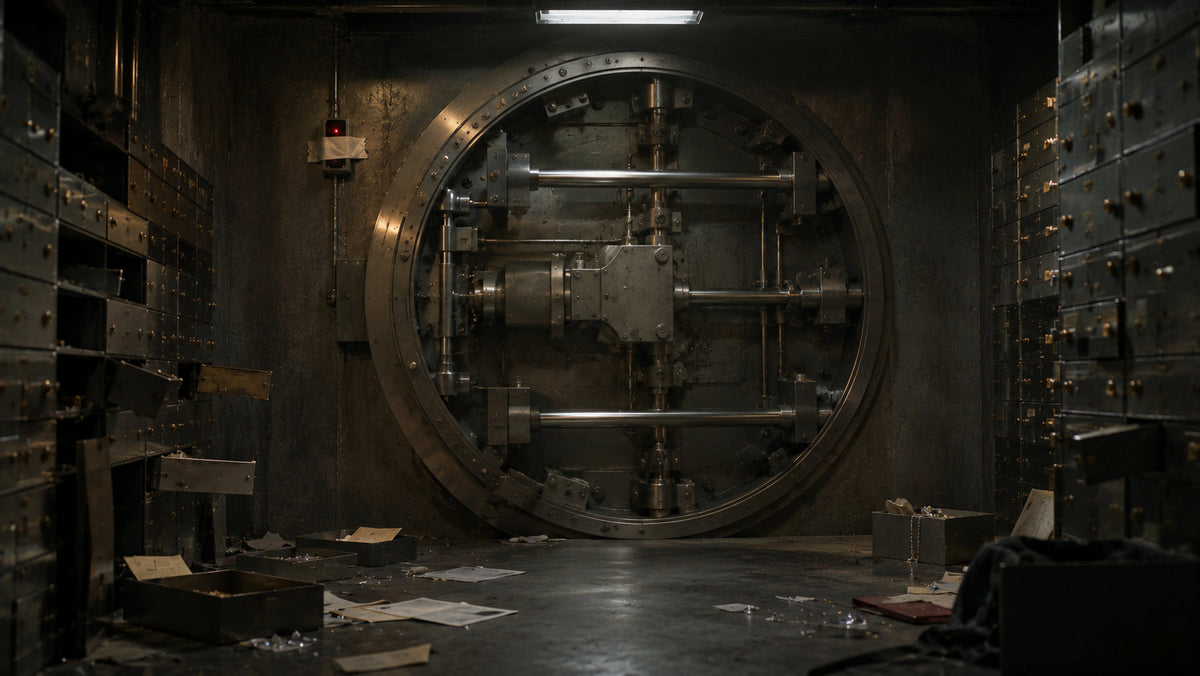
In February of 2003, somebody walked into a vault two floors beneath Antwerp's diamond district and emptied it. Over a hundred million dollars in diamonds, gold, and cash, out of more than a hundred safe deposit boxes. And here's the part that made it legendary: they never cracked the vault. The door, the foot-thick steel, the combination lock, all of it, still sitting there intact when the police arrived. The thieves went around the security instead of through it.
They call it the heist of the century. Netflix even used that name for its 2025 documentary, Stolen: Heist of the Century, directed by Mark Lewis. And it's usually told as a dazzling high-tech caper. So let's get into it. But I want to do it honestly, because the real story has two parts: the legend everybody repeats, and the shorter list of things anyone can actually prove. The gap between those two is its own lesson.
The version everybody tells
The famous version goes like this. The vault was protected by something like ten layers of security stacked on top of each other. A combination lock with a hundred million possible combinations. A heat-and-motion sensor that only tripped if it detected both at once. Magnetic sensors on the door. A seismic sensor to feel drilling. Doppler radar. A light sensor. On paper, a fortress.
And the crew, led by an Italian named Leonardo Notarbartolo, supposedly beat every single one. They filmed the combination with a hidden camera. They fooled the heat sensor with a cheap can of hairspray. They slid past the motion detection behind a homemade shield to hide their body heat. They bridged the magnetic sensors, taped over the light sensor, and got in and out with the vault's own alarms none the wiser. Beat the sensors, not the steel. It's a fantastic story.
Here's the thing, though. Almost all of those specifics trace back to one source: Notarbartolo himself, telling his version years later from prison. And the lead detective on the case flatly rejected it, saying not one detail of Leo's story could be confirmed by the actual investigation. So before we treat it as gospel, let's separate what he claims from what's on the record.
What we actually know
Strip it down to what's genuinely verified, and the story is honestly still remarkable, maybe more so.
- The steel was never beaten. This part is solid. Nobody drilled the door, cracked the combination by force, or blew anything open. The vault was opened with the combination and a working copy of its key. The strongest, most expensive part of the whole system, the part everybody thinks of as "the security," was simply never the thing that failed.
- They had a key to the building the whole time. This is the fact every account agrees on, and it's the one that matters most. Notarbartolo hadn't just cased the place. He'd rented an office and a safe deposit box inside the building, posing as a diamond dealer, for over two years. He had a badge. He belonged there. He could walk the vault level whenever he wanted, unhurried, unwatched, for as long as he liked. That access, not any gadget, was the real master key.
- One sensor really was just taped over. When police worked the scene, they found the vault's light sensor covered with a piece of tape. That detail is confirmed, and it's a perfect little illustration of the whole thing: a piece of tape beat a sensor. No magic, no movie gear. Tape.
- The boxes were brute force, not finesse. Once inside, the crew went through 109 of the vault's 189 safe deposit boxes using a custom hand-cranked puller. Every box had its own key lock and a little three-letter combination dial, and none of that mattered, because the tool just tore them open. Elegant on the way in, crowbar-simple once inside.

The elaborate hairspray-and-radar choreography? That's mostly Notarbartolo's telling, and security experts have poked real holes in it. A heat sensor blinded by hairspray should notice it's gone blind and throw a fault. A magnetic sensor you can physically reach and bridge is a bad sensor. Some of it may be true, some of it may be a good storyteller improving his own legend. We genuinely don't know. And I'd rather tell you we don't know than hand you a great line I can't back up.
The crew, as far as anyone knows
The police case pointed at a loose ring of Italian thieves the press dubbed the School of Turin. Notarbartolo, in interviews, gave his crew comic-book aliases and never matched a name to a face. Speedy, an anxious old friend who handled the getaway details. The Monster, a big man who was supposedly an expert picker, electrician, and mechanic all at once. The Genius, the alarm specialist. And the King of Keys, an older man described as one of the best key forgers alive.
Belgian police put real names to the first three, and those men went down with him. The King of Keys, the one who would have made that working vault key, has never been identified. If he exists as described, he walked, and he's still out there somewhere with the best resume nobody can read.
How it fell apart
And then there's the ending, which is almost comically human. They didn't get caught by a sensor. They got caught by garbage.
On the way out of the country, the crew dumped trash from the job on a strip of private land near the E19 motorway. The landowner, a man named August Van Camp, was sick of people littering on his property, so when he found a fresh pile the next morning, he went through it and called the police. In the bags: envelopes from the Diamond Center, a receipt, and a half-eaten salami sandwich. Police pulled DNA from the sandwich. Notarbartolo's own deposit box turned out to be one of the few in the vault left untouched, and five days after the heist he strolled back into the Diamond Center like any other tenant, where the diamond squad was waiting for him.
A dozen layers of vault security, beaten clean, undone by a sandwich in the woods. The most sophisticated part of the operation wasn't what got them. The most ordinary part was.
The coda runs even further. Notarbartolo got ten years in 2005, made parole in 2009, skipped the victim compensation he owed, and got re-arrested in 2013 during an airport layover in Paris to serve out the rest until 2017. His three named accomplices took five years each. And his big twist, the claim that the whole heist was really an insurance-fraud setup and they only got about twenty million? Experts don't buy it, and for the best reason imaginable: the vault had been denied insurance over its security flaws. The fortress everybody trusted couldn't even get covered. Most of the diamonds have never been found.
The real lesson
So what do you actually take from this, beyond a great story? A few things, and they're the same lessons every story on this blog keeps landing on.
First, the expensive lock is rarely the weak point. Antwerp had a serious vault and it held. What failed was everything around it: the access controls, the human procedures, the assumption that someone with a legitimate badge and two years of patience wasn't a threat. That's almost always where security actually breaks. Not the steel. The stuff around the steel.
Second, patient reconnaissance beats clever gadgets almost every time. The single most powerful tool in this entire heist wasn't a sensor trick. It was a man who was allowed to be there, watching, for two years. That's a real principle, and it's the same reason understanding your own routines and blind spots does more for you than any one lock you buy.
It's the same thread as the old unpickable-lock story from 1851, and the same thread as a bump key beating a fancy deadbolt. The lock is one piece of a system, and a determined person goes after the weakest piece, which is hardly ever the lock itself. If you want to understand the piece everybody obsesses over anyway, start here.
Anyways, try one thing this week. Walk into your own place, house, shop, office, whatever you've got, and look at it the way a patient visitor with a legitimate reason to be there would. Not the locks. The routines. What gets propped open, what code gets typed in plain view, who never gets a second look. Whatever you just thought of, that's your Antwerp. Handle that before you spend a dime on more steel. As always, I appreciate you.
Share:
How to Pick a Wafer Lock: the Lock in Your Desk, Filing Cabinet, and Car